Fixing a Noisy Breaker Box, Fast
A switchboard should be silent. Any buzz, hum, crackle or click coming from yours is the board telling you something isn't right behind that door.
Most of the time it's a fixable, unremarkable fault. Occasionally it's the first sign of something serious.
If you can feel warmth on the board, catch a scorched smell, or see any sparking, stop and call (02) 9134 9029 now.
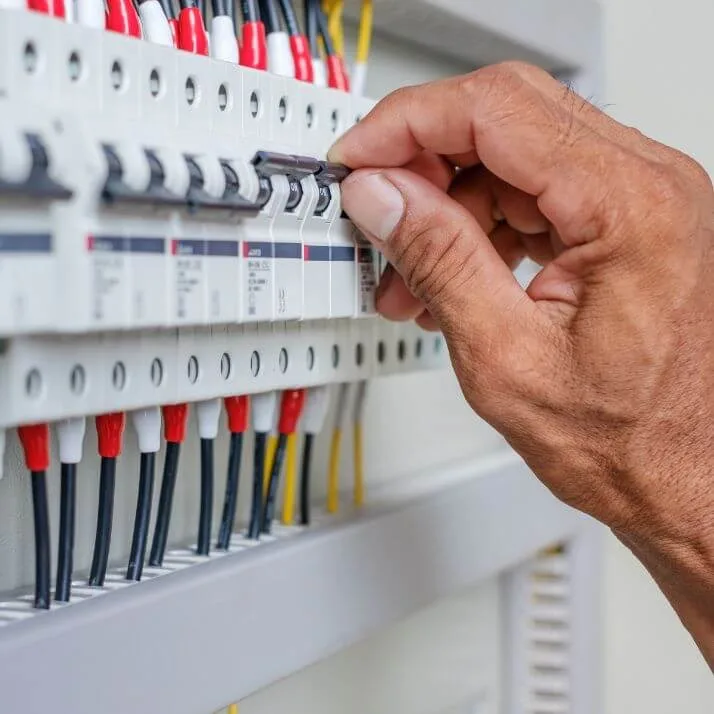
What a Noisy Breaker Box Actually Means
Every sound has a mechanical or electrical cause, never nothing.
A steady hum usually means current is arcing across a small gap rather than flowing cleanly through a solid connection. That gap might be a loose terminal, corrosion, or a breaker starting to wear out internally.
A clicking sound, especially one that repeats on a rhythm, often points to a breaker cycling on and off as it struggles to hold a connection.
Crackling or popping is the least subtle of the three and the one to treat most seriously. It usually means arcing has already begun, sparks jumping a gap rather than current flowing smoothly.
None of these noises fix themselves. They tend to get louder and more frequent as the underlying connection degrades further.
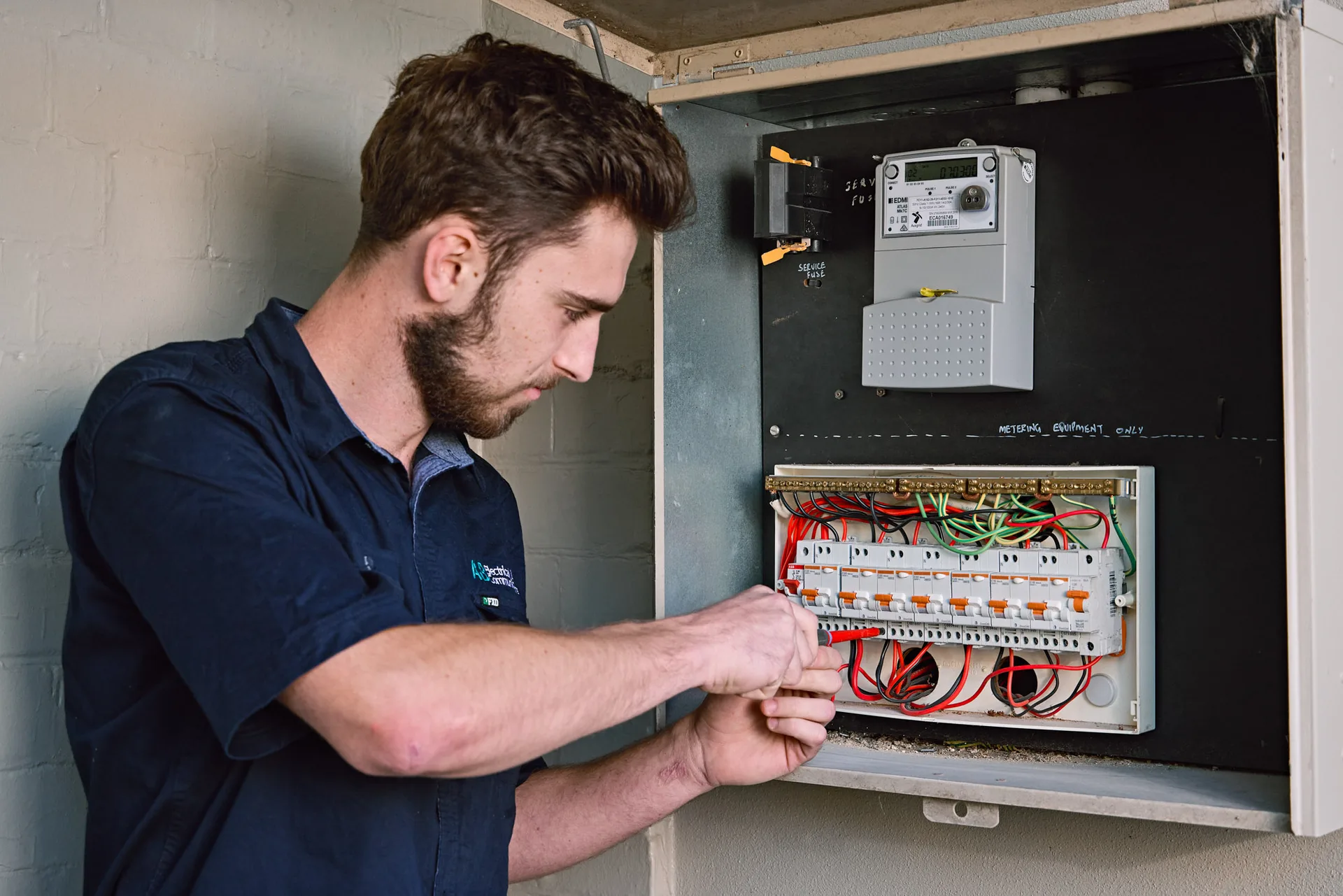
The Most Likely Causes
We find these in roughly this order, most common first:
- A terminal screw that's worked loose. Years of small vibrations and heat cycling do this gradually, not all at once.
- A breaker that's simply had its time. Older units lose their grip on a clean connection well before they stop switching altogether.
- Corrosion on a connection. Moisture or age can build resistance at a joint, which shows up as heat and noise.
- An overloaded circuit. A breaker working hard near its rated limit can hum audibly under load.
- An old-style fuse holder. Ceramic rewireable fuses sometimes buzz as contacts age, unlike modern breakers.
- The main switch itself wearing out. Least common, but a tired main switch can produce a constant, low hum on its own.
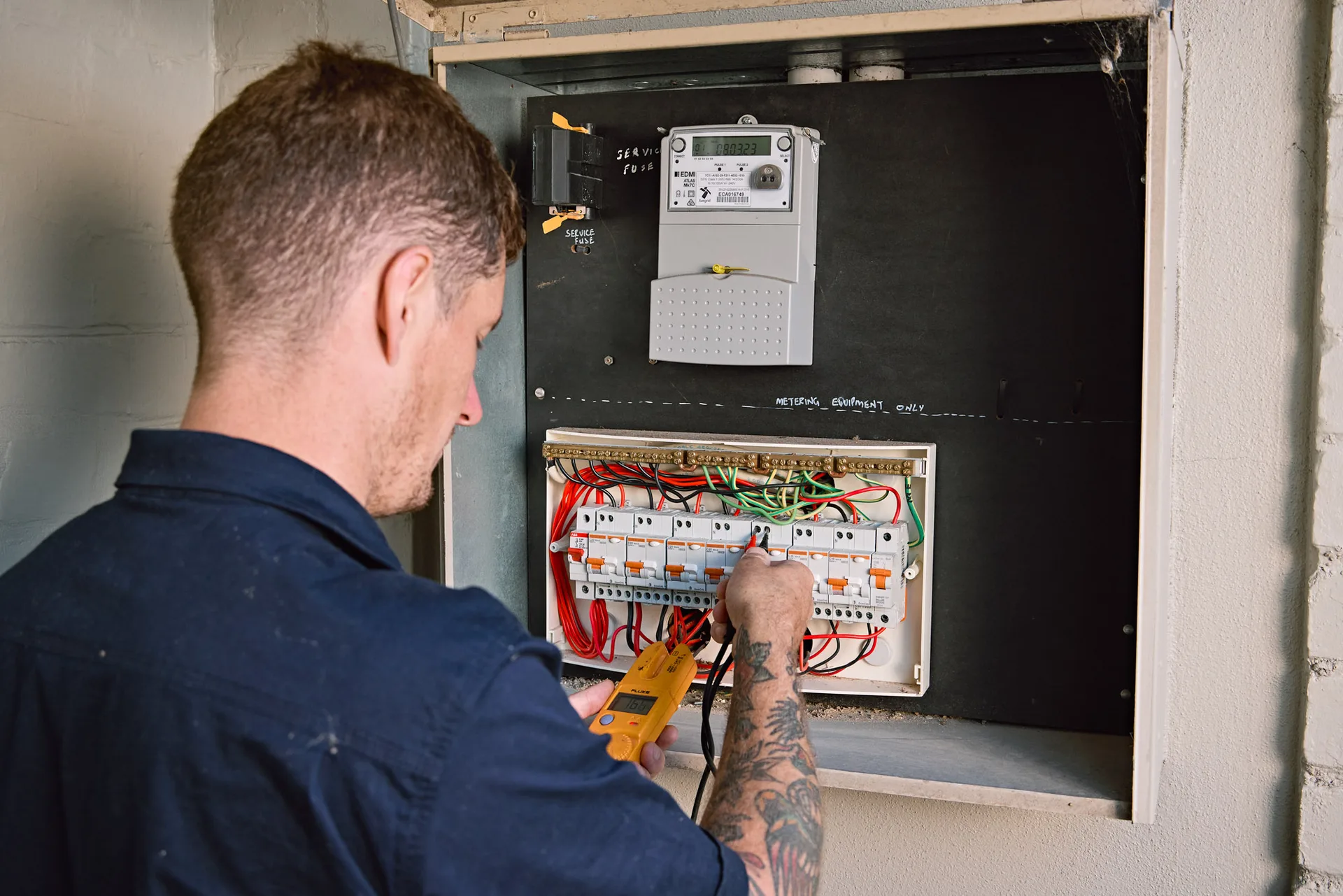
Should You Worry? An Honest Answer
A quiet hum with no other symptoms usually isn't urgent, but it is worth booking rather than ignoring.
What turns it urgent is anything else showing up at the same time: warmth on the board or wall, a scorched or hot-plastic smell, visible sparking, or marks around a breaker.
A noise that's getting noticeably louder week to week is also worth bringing forward, since it usually means the underlying connection is continuing to degrade.
If you can safely check, a warm patch on the board near where the sound is coming from is a strong signal to call now rather than wait.
Do This First
- Note which breaker the noise comes from, if you can tell. It helps us go straight to the fault.
- Feel for heat, carefully, without touching bare metal. A warm board changes this from routine to urgent.
- Switch off anything unusually loud if it's hot, then leave the rest of the board running as normal.
- Call us to book it in, sooner if the noise is new, sudden or getting louder.
How We Fix the Fault for Good
The board comes off load first, then each breaker and terminal gets checked in turn rather than us guessing which one's responsible.
A thermal camera earns its keep on jobs like this, since a connection loose enough to make noise is usually running warm too, and that's easy to miss with eyes alone.
From there it's either a re-terminated connection or a breaker swap, done to AS/NZS 3000. Notifiable work gets a Certificate of Compliance on completion.
A Local Angle on Noisy Breaker Box
Leichhardt's public library sits inside the Italian Forum precinct just off Norton Street, part of a mixed retail and residential building rather than a standalone civic block.
Buildings of that kind, older brick shells fitted out for shared commercial and residential use, often carry switchboards that were upgraded piecemeal rather than as one job. In a mixed-use building, board noise is frequently a sign one earlier addition wasn't terminated as cleanly as the rest.
It's a pattern worth flagging if your own place has had electrical work added in stages over the years rather than all at once.
How to Stop It Happening Again
Once a board's made noise once, a few steps guard against a repeat:
- Get every terminal checked, not just the noisy one. A switchboard upgrade is the natural time to do this properly.
- Move off an ageing fuse holder onto modern breakers, which hold a connection more reliably over time.
- Re-terminate older connections before they loosen further, rather than waiting for the next complaint.
- Even out the load across circuits, so no single breaker is working harder than it should be.
Nearby Suburbs and Related Faults
Dimming lights alongside the noise is its own thing, worth a read on our flickering lights page. A board that's actually cutting power, rather than just making noise about it, points to a breaker that won't hold instead.
Our regular run also takes in Haberfield, Rozelle and Petersham alongside Leichhardt.

Call Us Today, We Will Sort It
A board making noise is telling you something, and it rarely goes back to being quiet on its own. Call (02) 9134 9029 and describe what you're hearing, and we'll get it looked at properly.
Common questions
Leichhardt Noisy Breaker Box FAQs
The questions we hear most often about a board that's making noise.
Is a noisy breaker box an emergency?
Usually not straight away, but a loud buzz paired with heat, a burning smell or a switch that's hot to touch is. Ring us straight away if any of those show up alongside the noise.
What paperwork do I end up with?
A Certificate of Compliance for any notifiable job, lodged with NSW Fair Trading, so you've got proof on file that the board meets AS/NZS 3000.
How do I tell if it's one appliance or the board itself?
Listen for a pattern. Noise tied to one appliance switching on points to that appliance's circuit, while a steady hum regardless of what's running points to the board itself.
Do I need to switch anything off while I wait for you?
Not unless something feels hot to touch. With no heat, smell or visible damage, it's generally fine to keep using the board and circuits as normal until we arrive.
Could this actually start a fire?
Left long enough, yes. A loose or arcing connection keeps generating heat, and that heat is what eventually ignites nearby material, which is why it's worth booking rather than living with the sound.
What's your process for pinning down which breaker it is?
The board gets isolated, then every breaker and connection is tested one at a time, backed up by a thermal camera to catch heat a visual check alone would miss.